
Network security
Rising CVEs demand a technical review of your deployed firewalls
From July 2025 through September 2026, 97,311 CVEs were published in the NIST NVD. Telekomplex's free technical review examines what your firewalls actually run: deployed versions, effective configurations and operational evidence.
How many known vulnerabilities could be present in your firewalls and network devices right now? How quickly would your team detect them, confirm their applicability and address them?
From July 2025 through September 2026, 97,311 CVEs were published in the NIST NVD. September 2026 recorded 14,933, compared with 4,321 a year earlier: a 245.6% increase. [1]
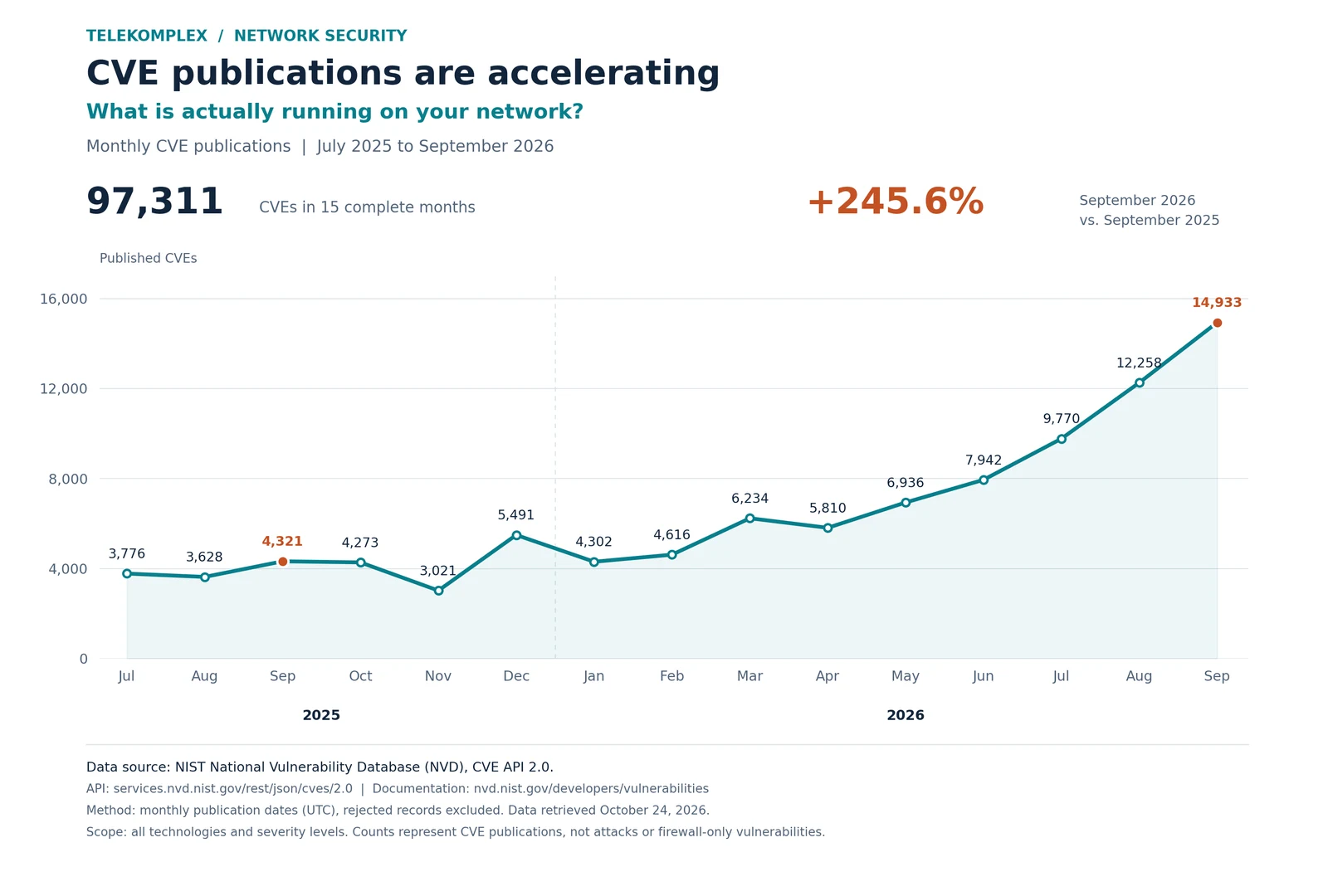
The chart covers all technologies and severity levels. It measures CVE publications, not attacks or firewall-only vulnerabilities. Your exposure depends on the products, versions, features and configurations actually deployed.
Telekomplex's free technical review examines the environment your company actually runs: deployed versions, effective configurations and operational evidence. IT policies and questionnaires provide context; they do not establish that a security control is implemented or working.
Attackers do not wait for your maintenance window
Attackers do not sleep. While your team checks compatibility, prepares backups, secures approvals and schedules maintenance, new vulnerabilities continue to be published.
If every update takes weeks to plan and deliver, new risks can emerge before the previous upgrade project closes. Can your patching process respond to an urgent vulnerability without leaving it in the project queue?
A firewall can keep traffic flowing while still requiring a security update. Understanding that exposure requires matching vendor advisories to running versions, enabled features and actual deployment conditions.
A technical assessment of what is actually deployed
Our Firewall Best-Practice & AI-Readiness Review is a free initial technical assessment of an agreed scope of your firewall environment. We inspect technical evidence from deployed systems, rather than treating policy statements or questionnaire answers as proof of protection.
Depending on your access requirements, we work through authorized read-only access, a guided session with your team, or current configuration exports and logs generated by the deployed platforms. We record the evidence and its date, validate what it supports and flag anything that cannot be verified.
The review focuses on four areas:
- The deployed estate: device models, running software versions, installed hotfixes and support status, checked against relevant vendor advisories and vulnerability conditions.
- Effective configuration: applied firewall rules, management access, enabled security profiles, logging and available operational evidence. A purchased license alone does not show that a control is enabled or effective.
- Update readiness: current redundancy and high-availability status, backups, dependencies, supported upgrade paths and recovery requirements.
- AI readiness: implemented visibility and access policies for AI applications, data-protection controls and audit records, including gaps that require identity, endpoint or cloud integrations.
Where agreed and supported, controlled read-only checks help validate configuration and operating state. The review itself makes no configuration changes. Any additional testing or production changes require a separate scope and authorization.
Findings grounded in evidence and a practical action plan
You receive a findings summary tied to technical evidence, prioritized recommendations and an initial plan for continuous updates and patching. Each finding explains what was observed, why it matters and the next action. Potential issues that need further validation remain clearly identified as such.
Priorities reflect known exploitation, actual exposure and business impact. CISA's KEV catalog helps identify vulnerabilities known to be exploited, while NIST treats patch management as an ongoing cycle of identification, prioritization, installation and verification. [2] [3]
The plan protects business continuity through testing, backups, phased changes and rollback procedures. We use high availability and non-disruptive updates where the architecture and vendor support them. When a maintenance window is required, we coordinate it with your team to reduce operational impact.
For cloud-delivered services, we also clarify which updates are managed by the provider and which components or controls remain your responsibility. The initial technical review and recommendations are free; implementation and ongoing support are scoped separately.
Certified engineering for your deployed technologies
We work with Palo Alto Networks, Fortinet, Cato Networks, Cisco, Juniper Networks / HPE and Check Point. Our engineering network includes professionals holding the highest-level certifications offered by the vendors we work with. We match specialists to the technology and scope of each engagement.
We support internal IT teams and MSPs, MSSPs, VARs and integrators that need additional engineering capacity, including delivery under your brand.
Request your free technical firewall and AI-readiness review
Register in the Resources section of the Telekomplex website. We will agree on the scope and evidence needed to review what is actually deployed, identify the priorities and build an update plan around your operation.
Sources
- NIST NVD. CVE publication data, API 2.0. API documentation · API endpoint
- NIST SP 800-40 Rev. 4. Guide to Enterprise Patch Management Planning. Official publication
- CISA. Known Exploited Vulnerabilities Catalog. KEV catalog
Data retrieved October 24, 2026. Complete months from July 2025 through September 2026. Counts use UTC publication dates, exclude rejected records and apply no vendor, product or severity filters. Year-over-year increase: (14,933 / 4,321 − 1) × 100 = 245.6%.